What does “mindful design” actually mean? (And why most designers don’t practise it)
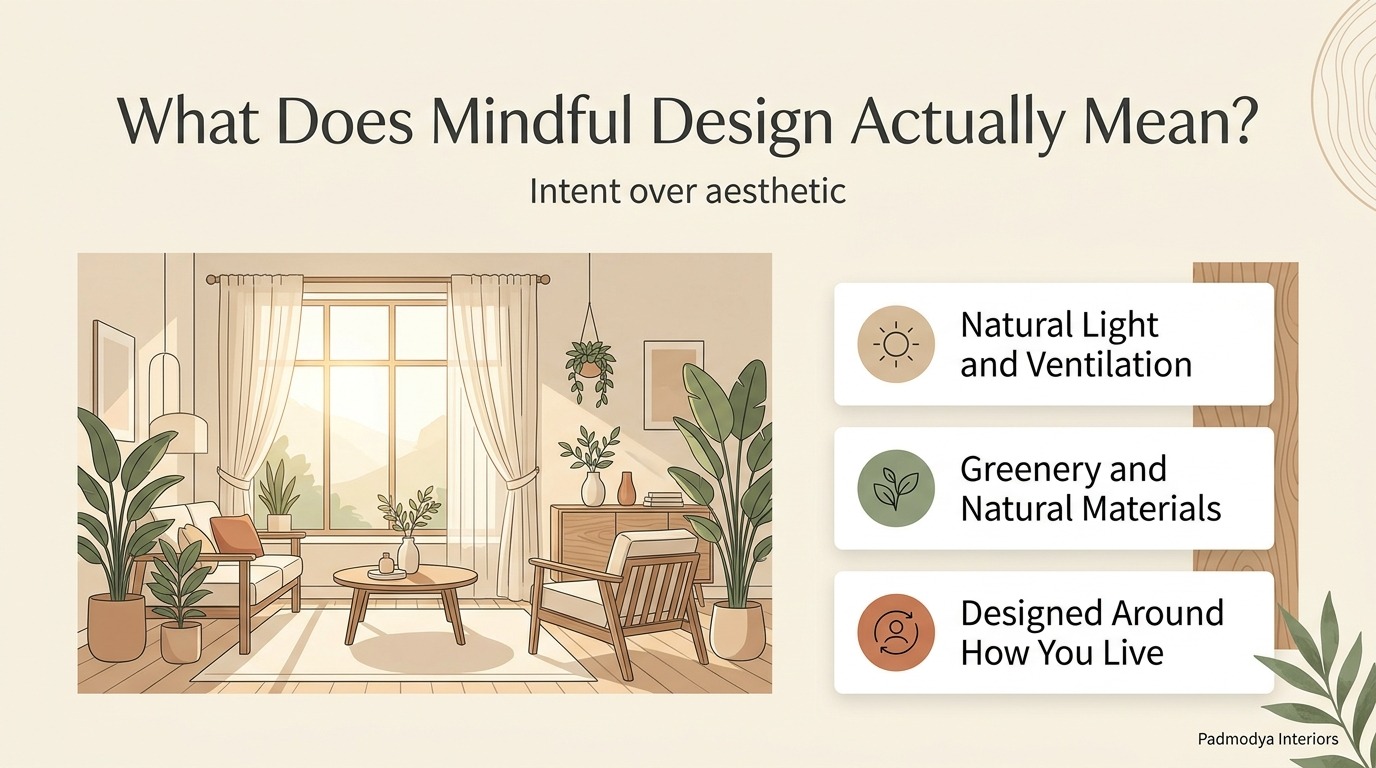
“Mindful design” has quietly become one of the most overused phrases in the interiors world. Almost every designer in Bangalore now sprinkles it across their homepage. Yet walk into the finished homes and you often find the same glossy, template-driven interiors dressed up in nicer words. So, what does mindful design genuinely mean, and why do so few designers actually practise it?
It is a way of deciding, not a style
Mindful design is not a colour palette or a Pinterest aesthetic. It is a discipline of intent. Every choice, from where a window sits to which material lines a cabinet, is made around how you actually live, not around what photographs well. It asks slower questions. How does morning light move through this room? Where does your family naturally gather? What will still feel calm here in ten years?
This is where the honest work happens, and it is also where most designers quietly opt out.
Why most designers skip the hard part
The reason is simple. Genuine mindful design takes time, and time is expensive. It is far quicker to reuse a proven layout, push a standard set of finishes and move to the next project. Personalising a home around one family’s rhythms cannot be templated, so it rarely survives a volume-driven business model. The phrase stays on the website. The practice does not make it to site.
There is also a measurable side that gets ignored. A scoping review of 136 studies on biophilic design found that natural light, greenery, natural materials and considered spatial layouts produce real gains in stress reduction, mood and cognitive function. Crucially, the researchers noted that benefits depend on thoughtful placement and integration, not on simply adding a plant in a corner. Mindful design is exactly that thoughtful integration. Decoration alone is not.
What it looks like when done right
You can see the difference in Bangalore homes and workspaces that treat nature and daylight as structural decisions rather than afterthoughts. Architectural Digest recently featured a Bengaluru space built as a climate-responsive sanctuary, where ventilation, greenery and orientation were designed in from the start, not styled on at the end. That is the tell. Mindful spaces are planned around wellbeing early, so calm feels built in rather than borrowed.
Practically, it shows up in small honest choices. Cross-ventilation that reduces your reliance on air conditioning. Storage placed where you already drop your keys. Low-toxicity finishes because you breathe that air every day. Materials chosen to age gracefully in Bangalore’s humidity rather than look perfect only in the handover photos.
We listen before we draw a single line.
For us, mindful design is not marketing language borrowed for a headline. It is the reason we start every project by understanding your lifestyle, values and daily routine before we design anything. We create sustainable, biophilic spaces that reflect how you truly live, backed by transparent pricing, no hidden charges and a 10-year warranty on the work.
The difference between a designer who says mindful and one who means it is patience. One rushes to a finish. The other listens first. If you want a home that feels genuinely yours rather than a copy of the last project, we’d love to design around your story.
Book a free consultation →